
Camunda Announces ProcessOS
An Operating System For Business Processes

Today at CamundaCon in Amsterdam, Camunda announced ProcessOS. The framing is bold: an operating system for business processes. It will be released with Camunda 8.10. If you have followed Camunda over the last year, this is the next big step after the push into agentic orchestration.
The short version is that ProcessOS is an intelligence layer that sits inside the Camunda Hub. It uses skills and agents to help you discover, design, build, and optimize processes. It works on your company data and gets better over time. The current AI coding agent is Claude Code, but the design is open and not locked to one model or vendor.
Camunda’s framing for this is direct: Every process in your enterprise is legacy, because it was designed for a world where AI did not exist. They call the work of redesigning those old processes into AI-native ones The Great Re-engineering. ProcessOS is meant to be the layer where that work happens. That framing is the main thread of this article, not the full feature list.
What ProcessOS Actually Is
ProcessOS is positioned as the intelligence layer of the Camunda Hub. The Hub also covers Web Modeler, Workspaces, Catalog, Console, the Business Value Dashboard, and the Agentic Control Plane. ProcessOS pulls these surfaces together with a loop of four activities: Discover, Design, Build, Optimize:
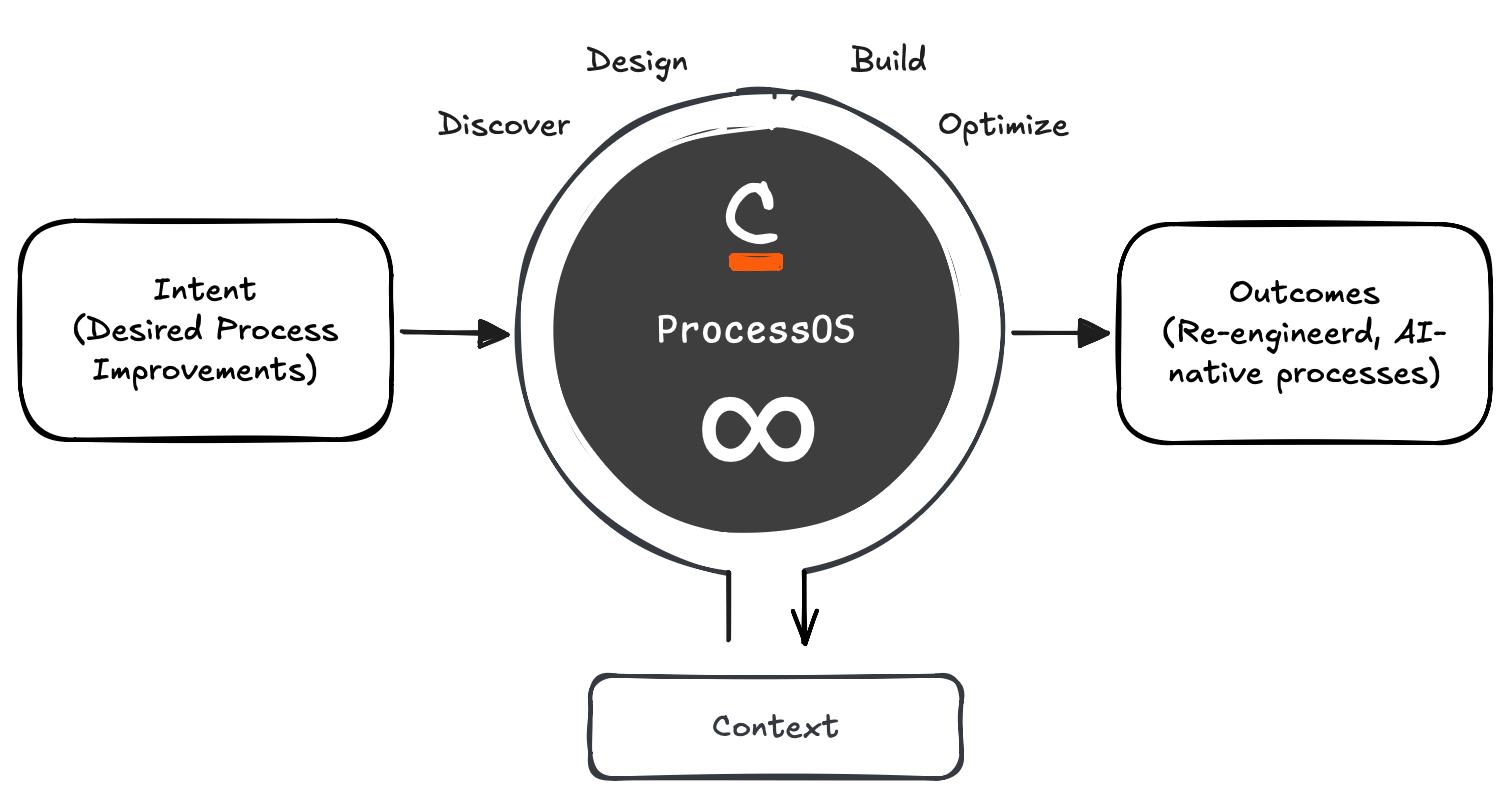
The inputs are intent, expressed as desired process improvements. The outputs are running, re-engineered, AI-native processes. In between, ProcessOS draws on two things. The first is organizational memory: knowledge, the catalog of connectors and building blocks, and policies. The second is signals: production data, live systems, and intelligence. That mix is what allows it to learn over time and stay grounded in the real company context, not just in a generic model.

For the people doing the work, there are three ways to use it. You can let agents act directly in an autonomous, agentic way. You can work with agent skills through a coding agent like Claude Code, with a human in the loop. Or you can edit manually in the Web Modeler with Camunda Copilot. Same skills, different levels of automation.
Why It Matters For Companies
Agentic orchestration was the first step. Camunda made it possible to use AI inside a running process, with the platform handling state, retries, and human escalation. ProcessOS is the next step. It uses AI before the process is even doing something, in the work of building the process itself.
For companies, the practical promise is speed. Prototyping and shipping production grade processes can move from months to weeks. That changes the economics of process work. It also changes who can take part. If an analyst can describe intent and get a working draft to review, the bottleneck is no longer only in the modeling tool. The review is still real and the governance is still real, but the first version arrives much faster.
The other point is strategic. Everyone is doing AI right now. What Camunda is offering with ProcessOS is a path where AI is not a feature bolted on the side, but a layer that knows your processes, your data, and your policies. That is a different conversation than just calling a model from a service task. It is the actual work of The Great Re-engineering: turning legacy enterprise processes, designed without AI in mind, into AI-native ones that fit how work gets done now.
From The Keynote
The announcement came from two speakers. Jakob Freund, Camunda’s CEO, opened with a direct question: are you truly ready for AI? His framing was that AI bolted on top of existing processes hits an automation ceiling. The early gains show up, but then coordination breaks down and the costs of chaos rise. The way through is to re-engineer the processes themselves, not to add AI to processes that were never designed for it. He also reminded the audience that agentic orchestration, announced six months ago in New York, is now live and battle proven at scale, with 16 customers already presenting at the event.
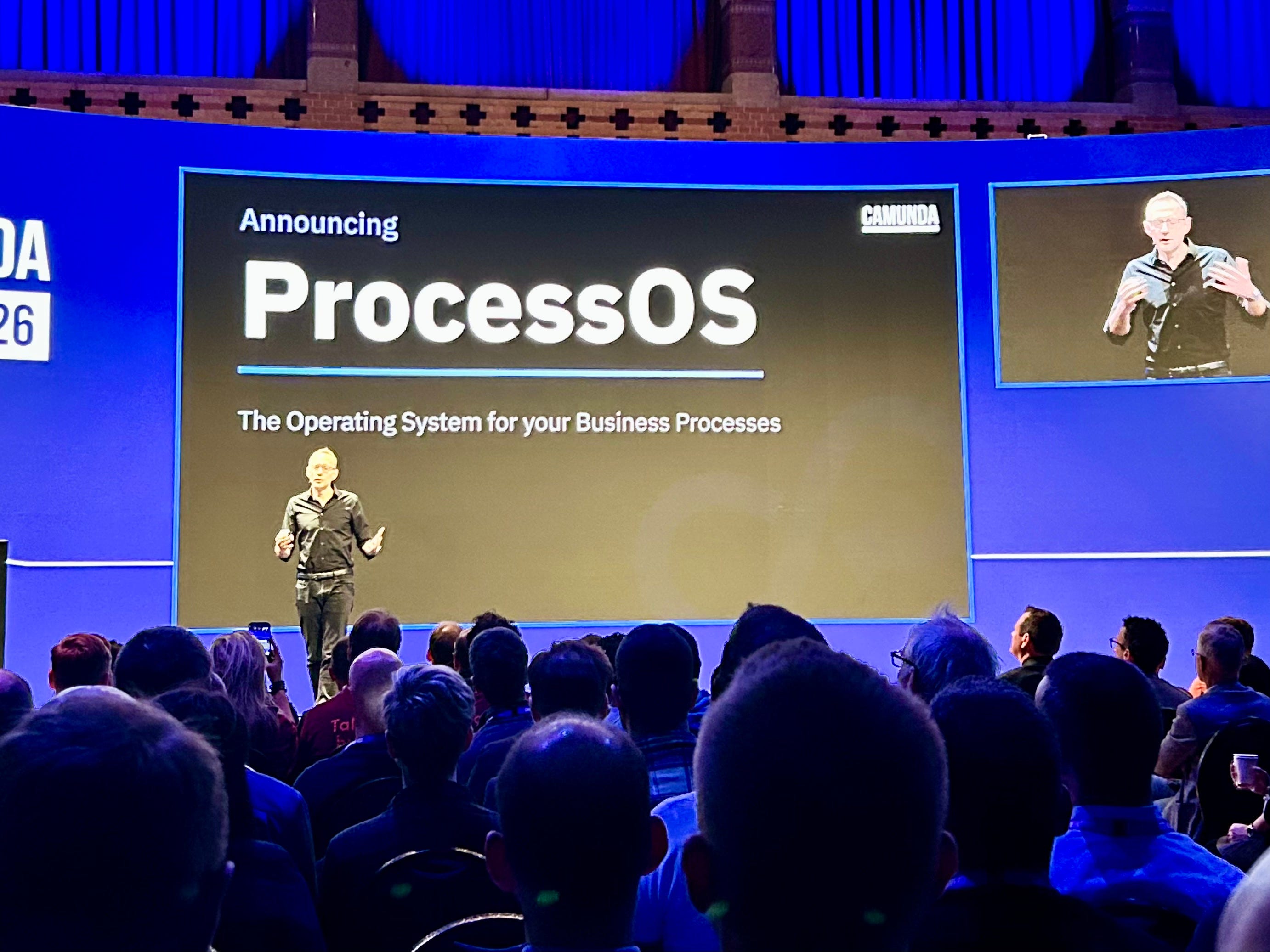
Daniel Meyer, Camunda’s CTO, then walked through what ProcessOS does in practice. Camunda used its own Quote to Cash process as the pilot. That process touches about 30 people across 6 divisions, 17 roles, 12 systems, and 14 document artifacts. Every euro of Camunda’s revenue runs through it. The Discovery Agent queried the real systems and produced markdown documentation in under an hour. About 66% of the input came from systems, the rest from short questionnaires for the people involved. A 3 hour stakeholder review followed.
The Design Agent then suggested a radical transformation. Collapse 20 to 79 touchpoints down to 2 in the happy path, with Slack as the single surface for employees and a new Deal Agent coordinating the other agents behind it. Guardrails and approvals stay enforced through BPMN where they are needed. The Build Agent generated the BPMN, DMN and other artifacts from that design, with engineers handling the remaining 20%. Four weeks of calendar time replaced the 9 to 12 months Camunda estimates for the traditional approach. The outcome: cycle time dropped from 115 days to 80, error rate from 10% to about 2%, and around 6000 person-hours freed per year, or about 5 hours saved per deal. The wider pilot, enablement and rollout are still pending, but the demo was meant to make the speed concrete, not just promised.
What’s Next
ProcessOS is in closed beta at the announcement and will arrive with Camunda 8.10. The parts to watch are how the Quote to Cash rollout goes beyond the demo, when the closed beta opens up, and how the skills and tools extend to coding agents other than Claude Code. I will follow up with a closer look once the release is out and the first hands-on examples are available.
If you want the official framing, watch for the keynote recording and the ProcessOS announcement page from Camunda after the event.
great read- thank you for sharing for those of us who can't be there live :)
It's an interesting framing for how to leverage AI in the design of processes (as opposed to, say, just talking about it as new process design tools). It certainly reads like high-value framing for what it promises to deliver!