
Measuring Organizational Maturity
A Brief Introduction To Maturity Models That Help Organizations Succeed
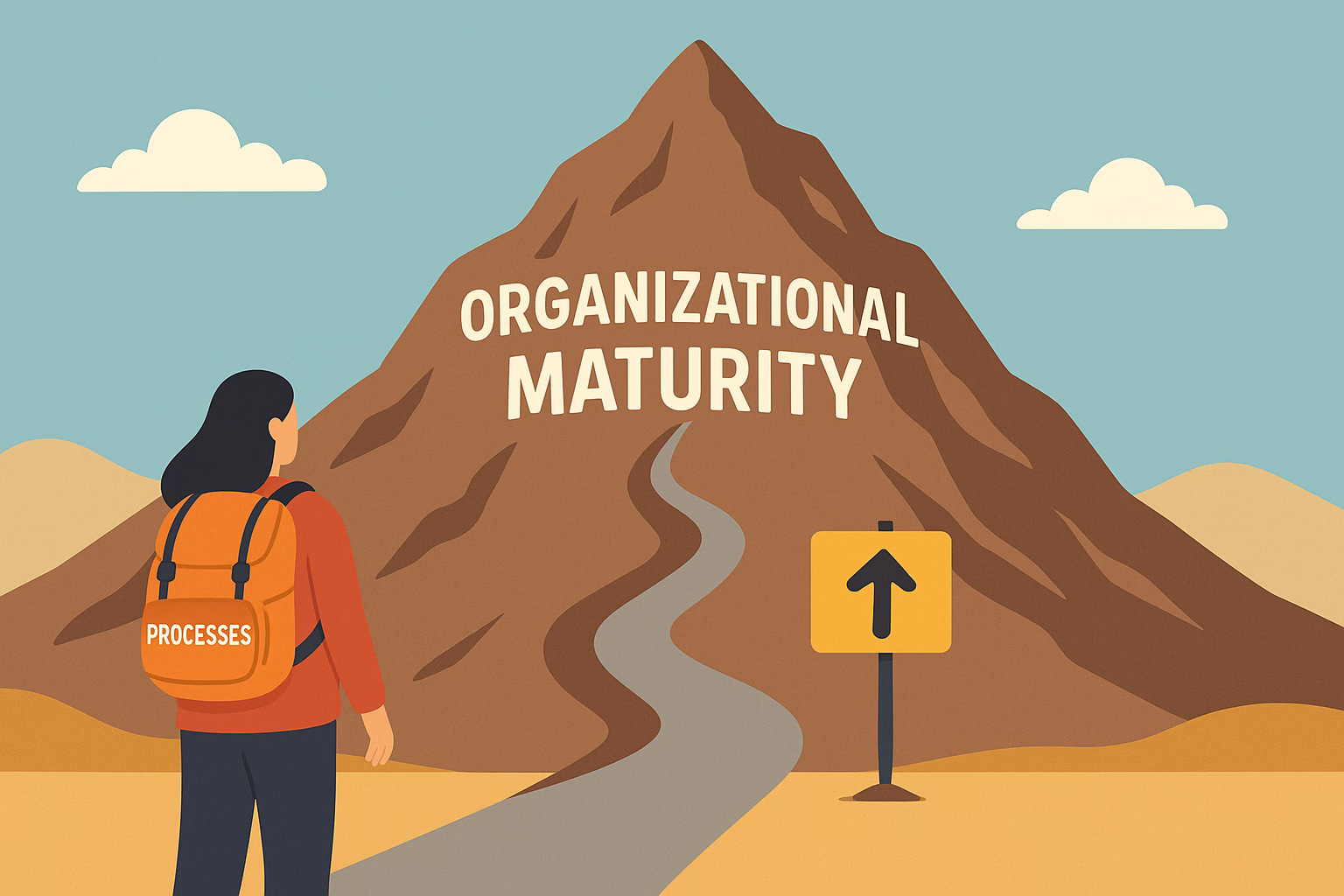
Maturity models are frameworks that help organizations assess their current capabilities in a specific domain and understand the steps needed to improve.
They break down complex areas like process management, software development, or orchestration into clear levels of progression, from ad-hoc or initial practices to optimized and innovative approaches.
With this article, I want to give you a quick overview of the most common models when it comes to Business Process Management. I’ll follow up with a more detailed post about each model and how they look like in real-life.
Capability Maturity Model Integration (CMMI)
💭 How Well Do We Build and Deliver Capabilities/Products?

Developed in the 1990s by the Software Engineering Institute (SEI) at Carnegie Mellon University, CMM (and later CMMI) was originally designed to assess and improve software and systems engineering processes, helping organizations consistently develop and deliver high-quality products and services.
Source: https://www.cmmiinstitute.com/learning/appraisals/levels
Focus: Measures process capability and performance, mainly in engineering and product/service delivery.
Goal: Enables organizations to develop, deliver, and maintain high-quality products and services consistently and efficiently by improving their capability maturity.
Example: Projects with very low maturity often get delayed or are over budget, while a high maturity allow projects to be measured and improved e.g. based on defined KPIs.
Business Process Management Maturity (BPMM)
💭 How Well Do We Manage, Measure, and Improve Our Business Processes?
Created in the 2000s by the Object Management Group (OMG), BPMM was designed to provide organizations with a framework to assess and improve the maturity of their business process management practices across industries, promoting standardization, measurement, and continuous improvement. CMMI had a big influence on its development.
BPMM can be mapped to CMMI “but [it] has been written to guide improvement of business processes, which tend to be more transactional and are better characterized as workflows across organizational boundaries rather than the more bounded project orientation of CMMI”1
Source: https://www.omg.org/spec/BPMM/1.0/About-BPMM
Focus: Measures process management governance, standardization, and improvement across the whole business.
Goal: Helps organizations achieve predictable, standardized, and continuously improving business processes that align with strategic goals.
Example: Low maturity means lots of manual work, without any process management, whereas a high maturity reflects organization wide usage of process management and improvement.
Process Orchestration Maturity Model (POMM)
💭 How Well Do We Orchestrate, Automate, and Scale Processes Across People and Technology?

Introduced by Camunda in the 2020s, the Process Orchestration Maturity Model was created to help organizations evaluate and improve their ability to orchestrate processes effectively across people, systems, and automation, focusing on scaling orchestration efforts to drive business outcomes.
Source: https://camunda.com/process-orchestration/maturity
Focus: Measures orchestration capabilities, evaluating strategy, structure, measurement, and tech adoption specifically for process orchestration.
Goal: Guides organizations in achieving effective, scalable process orchestration that delivers measurable business outcomes across people, systems, and automation.
Example: Low maturity means, there might be no or only minimal, siloed efforts to orchestrate, but not in a central or coordinated way. A high maturity, on the other hand, is giving organizations the ability to deploy process orchestration at scale across the entire company.
The Bottom Line
By using maturity models, organizations can benchmark themselves, identify gaps, set realistic improvement goals, and track their progress over time.
But most importantly: These models are not competing.
CMMI laid the foundation by focusing on capability development in software and systems engineering. BPMM expanded this approach to cover enterprise-wide business process maturity. POMM, in turn, focuses on a specialized area within BPM, evaluating and improving an organization’s process orchestration capabilities.
Stay tuned for more detailed articles about maturity models and how companies can apply them!
OMG, Foundations Principles of BPMM, https://www.omg.org/spec/BPMM/1.0/About-BPMM